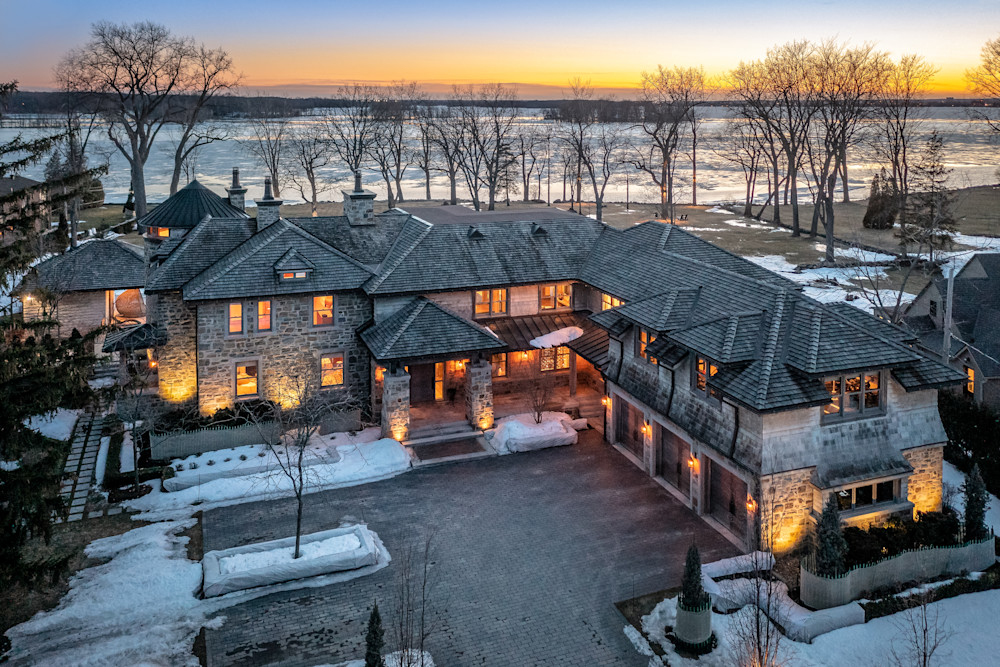
In Duvernay, beneath the canopy of mature maples, a mid-century California Ranch has been thoughtfully brought into the present.

At 365 Rue Hauterive, a single-storey residence stretches confidently across its plot, its long roofline and deliberate horizontality speaking the architectural language of 1950s Palm Springs — adapted for northern latitudes, then carefully expanded and modernized for contemporary life.
This is one of Duvernay’s celebrated El Rancho homes, part of a visionary mid-1950s development that brought West Coast modernism to suburban Quebec. While the neighbourhood’s ranch-style houses remain prized for their clean lines and single-storey ease, this particular property has been substantially reimagined. The interior has been opened and expanded, preserving the original architectural character while introducing the spatial generosity and amenities expected today.

The result is a home that honours its mid-century roots while functioning entirely for contemporary life. Where period details matter — the horizontal emphasis, generous windows, the seamless relationship to landscape — they remain intact. Where comfort and practicality matter — a reconfigured kitchen, refined bathrooms, dedicated laundry, thoughtful storage — they have been integrated with care and restraint.
The Ranch house, often misread as merely casual, is in truth deeply considered architecture. Its horizontality creates long sightlines and a gentle procession from public to private space. Here, that principle governs a thoughtfully expanded layout of three bedrooms, two full bathrooms, a powder room, and living spaces recalibrated for modern rhythms.

At the centre, the kitchen reads as a low, linear volume — a substantial island stretching parallel to the rear garden, reinforcing the home’s horizontal grammar. Cabinetry sits flush and deliberate, its clean planes allowing the eye to travel uninterrupted from prep surface to treetop beyond. Finishes are restrained: warm wood tones, pale stone counters, integrated storage that privileges calm over display. The island becomes both gathering point and visual hinge — dining to one side, living to the other, the garden always present beyond wide panes of glass.
Hardwood floors extend in long, uninterrupted runs across the principal spaces, amplifying the sense of breadth that defines the Ranch typology. Light moves laterally across these surfaces as the day progresses — catching the grain in the morning, settling into softer pools by late afternoon. The continuity of ceiling plane and flooring creates cohesion; boundaries between rooms are suggested through placement and proportion rather than walls.

Expansive windows trace the rear façade, framing the mature garden as a living tableau rather than a distant view. From the dining area, leafy branches feel almost within reach; from the living room, the horizontal line of fencing and tree canopy extends the architecture outward. In summer, doors open easily onto the terrace, dissolving the threshold between interior floor and exterior ground. In winter, snow gathers along the roof’s edge, sharpening the home’s linear silhouette against the landscape.
The primary suite occupies a quieter stretch of the plan — a retreat defined less by excess than by balance. A generous walk-in closet provides practical storage without interrupting the room’s calm geometry, while the ensuite continues the home’s disciplined material palette. Stone surfaces and full-height tile reflect natural light softly, maintaining cohesion with the broader interior language. The effect is contemporary comfort expressed with mid-century restraint.

Secondary bedrooms are modest yet well-proportioned, their ample windows and integrated storage reinforcing the home’s emphasis on functional elegance. A dedicated laundry room replaces the improvisation typical of houses of this era, treated not as an afterthought but as a purposeful, well-designed space.
Building a California-inspired house in Quebec has always required negotiation, and the recent renovations acknowledge this intelligently. Large expanses of glass frame views while respecting winter realities. Roof overhangs offer both aesthetic clarity and pragmatic shelter. Outdoor terraces and planted borders that soften the house’s geometry in summer become crisp architectural counterpoints against snow in winter.
True to Ranch tradition, the garden functions as an extension of the domestic realm rather than mere backdrop. The generous 7,314-square-foot lot — substantial by contemporary suburban standards — allows the architecture room to breathe. From within, greenery becomes a living mural. The house reveals different facets of itself throughout the year, each season offering a distinct reading.

In a market often defined by verticality and neo-traditional gestures, a well-executed mid-century Ranch feels quietly radical. This property’s strength lies not in extravagance but in coherence: period character preserved where it matters, contemporary comfort added where it is needed. Original horizontality, light, and connection to landscape — now paired with expanded living spaces, modern systems, and thoughtful storage.
Just minutes from Montréal, close to amenities and public transit yet sheltered on a quiet, tree-lined street, it offers something increasingly rare: one storey, no stairs, and a measured relationship between architecture and landscape.
A rare example of mid-century optimism translated with intelligence — and sustained with care.